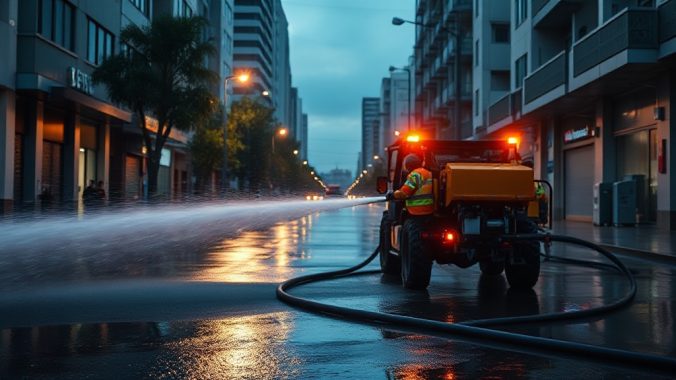
Hydrojetting on a Campo Limpo Street: What the High-Pressure Hose Actually Does
You hear it before you see it: a low, steady roar, then the slap of water against metal as a coiled hose disappears into a drain outside a bakery or a residential gate. That sound is hydrojetting, and on a Campo Limpo street it usually means a blockage has moved past the plunger-and-pipe stage. If you have been searching for a desentupidora Campo Limpo, this is the technique you are most likely to see in action.
Hydrojetting is not a bigger version of a drain snake. It is a cleaning method that uses water at controlled high pressure, pushed through a specialized nozzle, to scour the inside walls of a pipe rather than simply punch a hole through the clog. Understanding what happens during those minutes of noise explains why crews choose it, what it can and cannot fix, and what you should expect if a truck pulls up outside your building.
What the high-pressure hose is actually doing inside the pipe
The visible part is a hose being fed into a cleanout or a floor drain. The working part is the nozzle at its tip. Most hydrojetting nozzles are designed to do two things at once: spray water forward to break up the mass ahead, and spray backward to pull the hose deeper and flush debris toward the exit. That backward spray is why the hose seems to crawl into the pipe on its own.
Pressure is only half the story. Flow volume matters just as much, because it is the volume that carries grease, soap residue, sand, and paper pulp out of the line instead of leaving them to settle again a few meters downstream. A crew will usually start at a lower setting and increase it once they see how the pipe responds.
Water, not blades
A mechanical snake cuts or pushes through a blockage. Hydrojetting scrubs the full circumference of the pipe. That difference matters in older buildings where grease has layered onto the walls for years: the drain may run slowly rather than stop completely, and a snake can pass through without removing the coating that keeps causing backups.
The nozzle is chosen for the job
Different nozzles handle different problems. A penetrating nozzle focuses on a hard clog, while a flushing nozzle is built to wash a long section of pipe. For grease-heavy restaurant lines, the crew may use a nozzle with rotating jets. The choice is made on site, after the technician sees the pipe diameter and the type of waste.
Why Campo Limpo streets see this technique so often
Campo Limpo mixes narrow residential streets with busy commercial frontages, and that mix creates the conditions hydrojetting is good at handling. A single block can have a bakery, a small restaurant, a laundromat, and several apartment buildings sharing an older underground network. Grease from kitchens, lint from laundry, and ordinary household waste all meet in the same pipes.
Many of these buildings were plumbed decades ago, and some have had extensions, extra sinks, or new bathrooms added without a full review of the drainage capacity. When flow slows in that kind of network, the cause is often accumulated buildup rather than a single object stuck in the line. That is exactly the situation where a desentupidora Campo Limpo São Paulo SP team is likely to recommend hydrojetting over a simple rodding job.
Rain also plays a role. In heavy downpours, stormwater can overload older lines, and the debris that settles afterward narrows the pipe further. A crew called out after a backup may find roots, silt, and grease combined, which is more than a plunger or a hand snake can clear.
When hydrojetting is the right call and when it is not
Hydrojetting is a strong option for grease buildup, soap scum, sediment, and soft blockages in pipes that are structurally sound. It is also used as preventive maintenance in commercial kitchens and condominiums, where clearing a line before it fails is cheaper than an emergency call at night.
It is not the right tool for every situation. A collapsed pipe, a badly cracked section, or a line already weakened by corrosion can be damaged by high pressure. That is why a responsible crew inspects before blasting. A camera inspection, when available, shows whether the pipe can take the pressure or whether a different approach is needed.
Situations where the crew may choose another method
- Fragile or corroded pipes that could crack under pressure.
- Hard objects such as toys, bottles, or construction debris that need to be retrieved or broken up first.
- Root intrusions that require cutting before the line can be cleaned.
- Lines with no proper access point, where a cleanout may need to be opened first.
For a resident, the practical takeaway is simple: if a technician arrives and inspects before starting, that is a good sign. If someone offers to hydrojet immediately without checking the pipe condition, ask questions.
What you will hear, see, and smell during the service
The noise is the first thing neighbors notice. A hydrojetting unit is louder than a pressure washer and runs steadily rather than in bursts. Inside the building, the sound travels through the pipes, so a drain in a back kitchen may be audible in a front room. This is normal and usually lasts from a few minutes to under an hour, depending on the length of the line.
You may also see water and debris coming out of a cleanout or an inspection opening. The crew typically places a container or a protective mat to catch the discharge, but some splashing around the access point is common. After the job, the line should drain faster, and standing water in floor drains should disappear.
Smell is part of the process too. Disturbing years of buildup can release odors that were trapped in the pipe. Ventilating the area and running water through the drains afterward helps clear it. If a strong smell persists for more than a day, it is worth calling the crew back to check that the line is flowing freely.
What a professional crew brings
A proper hydrojetting setup includes a high-pressure pump, a reel of hose rated for the pressure used, a set of nozzles, and protective equipment for the technicians. In a dense neighborhood like Campo Limpo, the crew also needs to manage the hose run from the truck to the access point without blocking a driveway or a sidewalk for longer than necessary. A desentupidora em Campo Limpo São Paulo SP that works in the area regularly will be used to those constraints.
How to judge whether the job was done properly
The clearest sign of a good hydrojetting job is not the noise or the volume of water used. It is how the drain behaves in the days that follow. A line that was cleaned properly drains at a steady rate, does not gurgle, and does not back up when several fixtures are used at once.
Ask the technician what was found and what was removed. Grease, sand, paper, and roots each tell a different story about the pipe. If the crew used a camera before and after, ask to see the footage, especially if the same line has backed up more than once. Recurring blockages in the same spot often point to a structural problem rather than a cleaning problem.
Finally, keep the access point clear. A cleanout that is buried under a planter or covered by a paved slab makes every future service slower and more expensive. In a neighborhood where buildings share tight spaces, a few minutes spent marking and clearing the cleanout can save hours later.
The high-pressure hose is a tool, not a cure-all. On a Campo Limpo street, it is most useful when the problem is buildup in a sound pipe, and it is most valuable when the crew inspects first, explains what they found, and leaves the line flowing the way it should.
Leave a Reply